
Conceptual Model#
Purpose#
This page is didactic. It does not start from package names or output files. It starts from one physical scene: a land surface, a groundwater head, and possibly a line support on the surface.
The same scene can lead to three different modelling decisions:
impose an exchange condition on a known stream support;
let groundwater emerge where the solved head reaches the surface;
convert simulated emergence into an active-network diagnostic.
Those decisions are close in space but different in meaning. Keeping them separate is what prevents the documentation from treating a river line, a seepage flux, and a validation mask as if they were the same object.
In the sketches below, a river is intentionally drawn as a line or support on the land surface, not as a cross-sectional water body with thickness. The question is groundwater-surface exchange: where is the groundwater head relative to the local topographic or channel surface?
Three Questions, Three Methods#
Scientific question |
Method family |
Prescribed object |
Computed object |
|---|---|---|---|
I know the surface support and want exchange against a known hydraulic level. |
Stream-style boundary |
support |
exchange flux |
I want the model to decide where groundwater emerges at the surface. |
Seepage or drainage operator |
support |
one-way outflow |
I want a map of the stream network implied by simulated emergence. |
Simulated-active diagnostic |
positive seepage field and routing graph |
accumulation |
The methods are therefore not a hierarchy of increasingly detailed rivers. They answer different questions. The stream boundary is a hydraulic exchange condition. Seepage is a surface-emergence condition. The simulated-active network is an interpretation of model outputs.
Method 1 - Stream Boundary#
Use this method when a surface support is known and a hydraulic level can be assigned to it. The support may come from observed linework, generated hydrography, or a model-specific package input, but the important point is that the support and its stage/head exist before the groundwater solve.
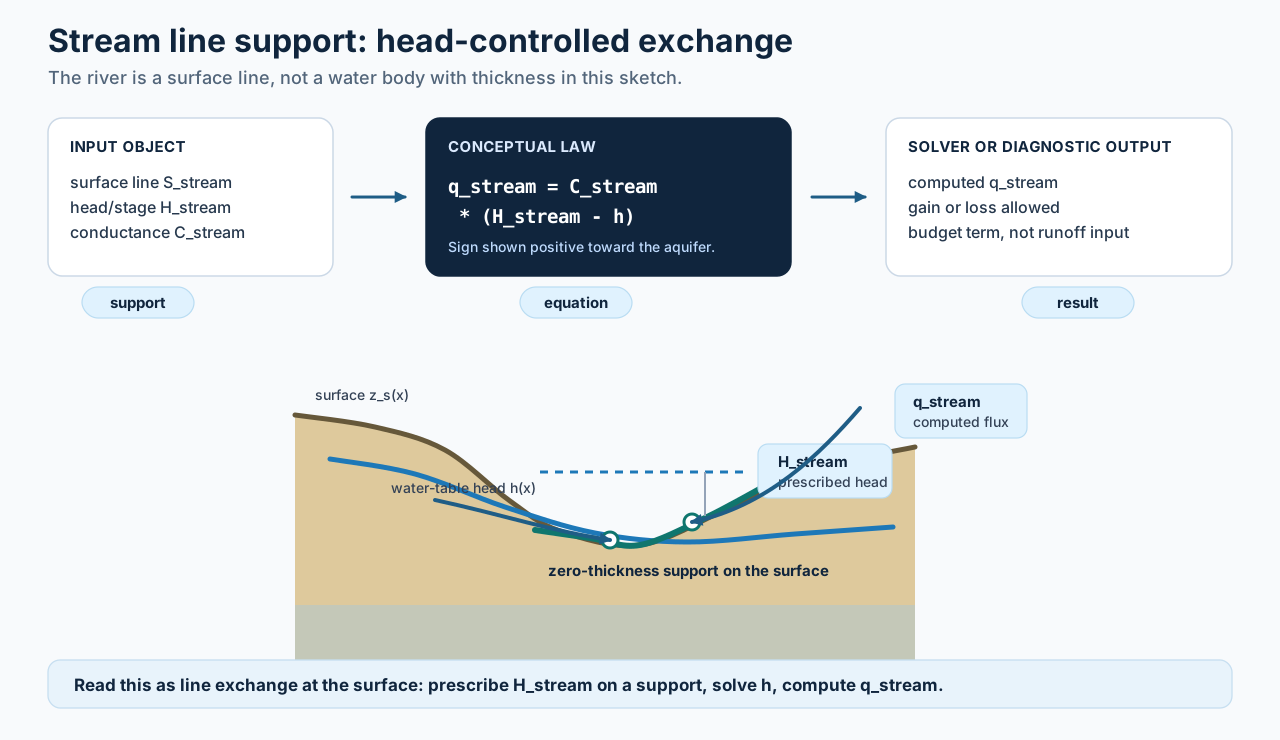
Fig. 86 The method starts from a zero-thickness surface support. The prescribed
value is the hydraulic level on that support, not a drawn volume of river
water. The solver computes the exchange flux after solving h.#
Once this physical reading is fixed, the schematic law is:
In this notation, positive q_stream is drawn toward the aquifer. If
H_stream > h, the boundary supplies water to the aquifer. If
H_stream < h, the sign reverses and the aquifer discharges toward the
support. The conductance controls the strength of the coupling. It does not
turn the support into a surface-water routing model.
The intelligent use of this method is therefore not “there is a river, so use stream”. It is: “I have a support and I accept prescribing its hydraulic level as an external condition.”
Method 2 - Seepage Or Drainage#
Use this method when the active exchange should be decided by the solved groundwater head. The support still exists, but the method does not prescribe a stream stage. It asks whether the solved head reaches the local surface.
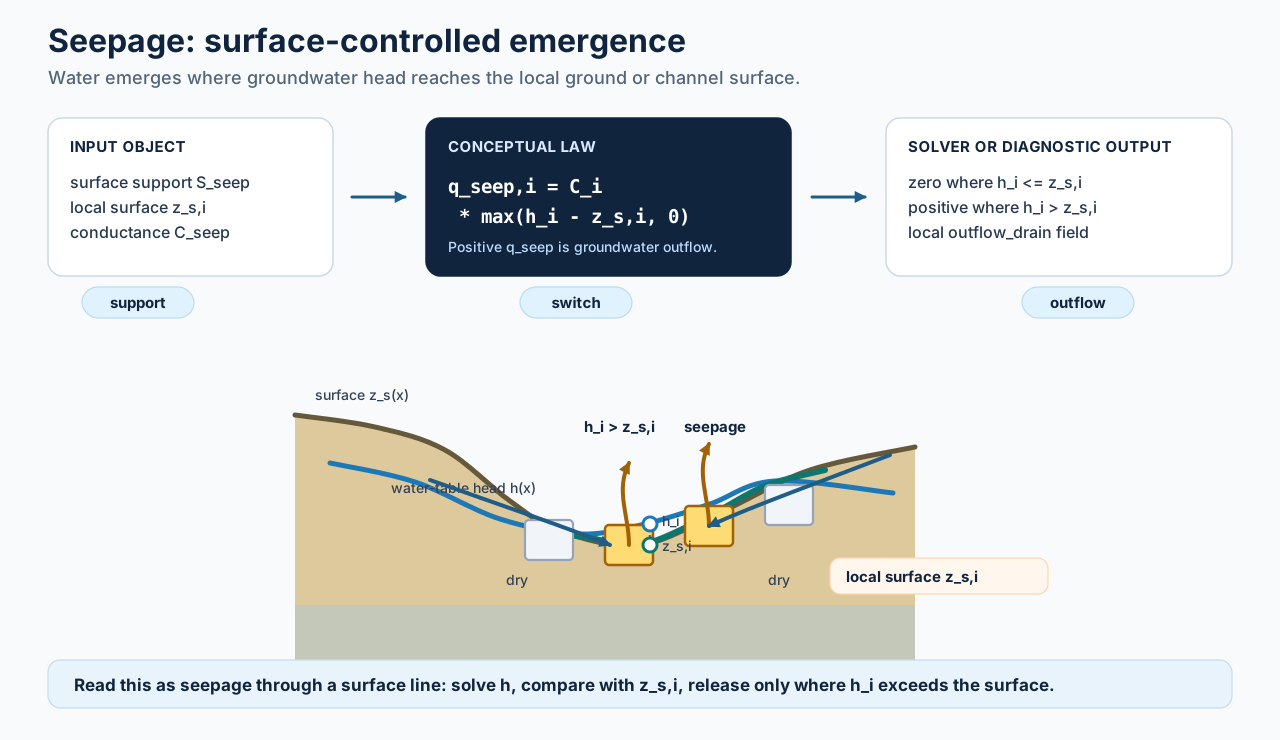
Fig. 87 The surface line is the activation reference. Where h_i remains below
z_s,i, there is no surface outflow. Where h_i reaches or exceeds the
surface, groundwater can emerge and the excess is released as seepage or
drainage outflow.#
The compact expression is:
The equation is best read as a surface inequality, not as a small river
formula. Below the surface, the outflow is zero. Above the surface, the
positive excess head is converted into an outflow controlled by conductance.
In HydroModPy outputs, this local positive release may still be stored or
compared under drainage names such as outflow_drain.
The intelligent use of this method is: “I do not want to prescribe the active river level. I want emergence to be a consequence of the groundwater solution.”
Method 3 - Simulated Active Network#
Use this method after the solve, when the question becomes geographical rather than hydraulic: which parts of the landscape are active according to the simulated seepage or drainage field?
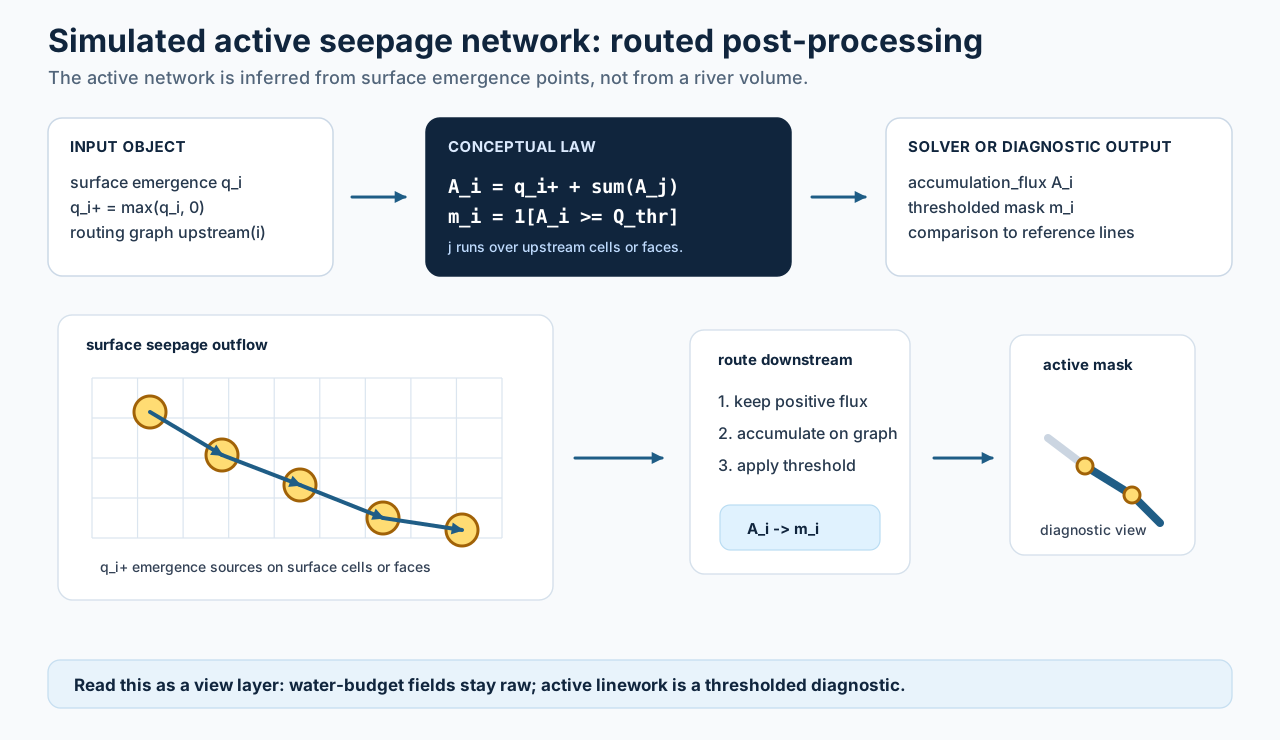
Fig. 88 The active network is inferred from surface-emergence points and routed downstream. It is not a new boundary condition and it does not create a river volume in the groundwater solve.#
The post-processing logic is:
Here A_i is an accumulated diagnostic flux, U(i) is the set of upstream
cells or mesh faces, and m_i is a thresholded active-network mask. The mask
is useful for visual interpretation or comparison against reference linework,
but it is not itself a water-budget term.
The intelligent use of this method is: “I need a map-like interpretation of where the model predicts active seepage-connected drainage, and I must state the threshold or time-window rule used to obtain that map.”
Choosing Between The Methods#
If your known information is… |
Prefer… |
Because… |
|---|---|---|
A known stream support and an acceptable prescribed stage/head. |
Stream boundary. |
The main uncertainty is the exchange magnitude, not the existence of the boundary level. |
A surface where groundwater may or may not emerge. |
Seepage or drainage operator. |
The active outflow must be decided by the solved groundwater head. |
A simulated outflow field and an observed network to compare against. |
Simulated-active diagnostic. |
The hydraulic solve is finished; the remaining question is spatial interpretation and validation. |
A need for routed channel hydraulics, water depth, or downstream surface flow storage. |
A surface-water routing concept, not the methods on this page. |
These sketches intentionally do not represent river thickness or channel water volume. |
This is the key separation: stream boundaries prescribe a hydraulic level, seepage operators impose an emergence rule, and simulated-active networks interpret outputs. They can be connected in a workflow, but they should not be collapsed into one vocabulary word.
From Concept To Evidence#
After choosing the method, do not jump directly to the most attractive figure. Use examples that preserve the same separation:
if the question is conceptual choice, stay on this page and compare the three method sketches;
if the question is what is implemented and what is still a non-contract, read Status And Limitations;
if the question is the MODFLOW 6 implementation path, read Simulated Active Network and check the sequence
head->outflow_drain->accumulation_flux-> mask;if the question is sensitivity on a real basin, read Nancon K-Sweep Results;
if the question is a legacy MODFLOW-NWT baseline, read the Nancon capability gallery case linked from Worked Examples;
if the question is what to open after a comparison run, use Worked Examples and Comparison Output Reading Order.
The rule is the same in every example: the files are useful only when the method role, support role, computed field, and validation target are explicit.
Implementation Maps#
The diagrams below are implementation maps. They are useful after the method logic above is clear.
Read this diagram left to right:
A stream-style exchange starts from a support and a known stage/head.
A seepage/drainage exchange starts from a support, conductance, and local surface elevation.
In both cases, the exchanged flux is a solver result, not an observed runoff time series.
This decision tree is useful when reading results.
If the question is water balance, use
outflow_drain.If the question is active stream structure, use
accumulation_fluxor a mask derived from it.If the question is validation against observed hydrography, compare the mask with
referencelinework.If the question is a persisted vector stream network, define the threshold, timestep/window, and vectorization rule first. HydroModPy does not silently invent that canonical vector role.
Common Mistakes#
Avoid these interpretations:
streamdoes not currently mean full surface-water routing.seepageis not diffuse recharge in reverse; it is a conditional surface release controlled byh - z_s.outflow_drainis not the same object as a river line.accumulation_fluxshould not be summed as a water-budget term.simulated_activeis not a measured network unless it is explicitly compared withreference.